
How to buy B2B data in India legally (DPDP Act basics)
Short answer: you can buy and use B2B data in India legally if you treat every named person in it as personal data under the Digital Personal Data Protection Act, 2023 (DPDP Act). Buy from a provider that can show where each contact came from, use it only for a clear business purpose, tell people who you are and how to opt out in your first message, honour every opt-out across your team, respect the telemarketing (DND) rules for calls and SMS, and keep records. Company-level facts (a company name, its industry, its city, a published office phone) are not personal data; the person behind a work email is.
This guide explains the rules in plain words for sales and marketing teams. It is not legal advice: for a large programme, read the Act and the Rules yourself and speak to a lawyer.
Disclosure: this guide is published by LeadSetu, which sells B2B data with a CRM built in. Where we describe how LeadSetu handles a point, we say so.
Contents
- Company data and personal data
- What the DPDP Act asks of you
- Calls, SMS and the DND register
- What a lawful dataset looks like
- How to buy B2B data legally in India
- Questions to ask a data provider
- Frequently asked questions
- Sources and method
Company data and personal data
The first thing to get right is what kind of data you are buying. A B2B dataset usually mixes two kinds of fields:
| Field | Usually personal data? | Why |
|---|---|---|
| Company name, industry, city, state | No | It describes a business, not a person |
| Company website and a general office phone | No | It belongs to the business |
| A shared mailbox such as an info or sales address | Usually no | It is not tied to one person, though a one-person firm is a grey area |
| A named person and their job title | Yes | It identifies an individual |
| A person's work email or mobile number | Yes | It identifies and reaches an individual |
| A sole proprietor's own details | Yes | In a proprietorship the business and the person are the same |
Most of the value in B2B data is in the second half of the table: the people who decide. So in practice almost every useful B2B list contains personal data, and the DPDP Act applies to how you use it.
To give a sense of the split in a real dataset: across the 1,17,011 Indian IT and software companies in LeadSetu on 10 November 2026, 87,890 (75.1%) have a published business email and 81,530 (69.7%) a phone number, while 42,101 come with named people and 28,951 with at least one decision maker. The company-level fields cover most records; the named-people layer, where the legal duties sit, is smaller and needs the most care.
What the DPDP Act asks of you
The DPDP Act was passed in August 2023. The Digital Personal Data Protection Rules were notified in November 2025, with most duties phased in over the following months; check the official text for the dates that apply to you. In the Act's words, the person a record is about is the Data Principal, and the business that decides why and how data is used is the Data Fiduciary. When your sales team uses a bought list, your company is a Data Fiduciary for that use.
The duties that matter most for B2B outreach:
- A lawful ground. The Act's main ground is consent: free, specific, informed, unconditional and unambiguous, given by a clear action. It also lists certain "legitimate uses" that do not need consent; these are narrow, so do not assume cold outreach fits one of them.
- Notice. When you ask for consent you must say what data you hold, why, and how the person can withdraw consent or complain.
- Publicly available data. The Act does not apply to personal data that the person themselves has made publicly available, for example a director who publishes their work email on their company's contact page. This is narrower than "anything on the internet": data a third party published about someone is not covered by this exception. Ask your provider which page each email came from.
- Purpose limits. Use the data for the purpose you collected or bought it for, and delete it when that purpose is over.
- Accuracy and security. Keep data accurate where it is used for a decision, and protect it with reasonable security safeguards.
- Rights. People can ask what you hold, ask for correction and erasure, withdraw consent as easily as they gave it, and complain. You need a way to receive and act on these requests.
- Penalties. The Data Protection Board can impose penalties of up to 250 crore for some failures, such as not taking reasonable security safeguards.
None of this stops B2B prospecting. It means three habits: know where every personal detail came from, make opting out easy and permanent, and use the data only for business-to-business outreach that the person would reasonably expect.
Calls, SMS and the DND register
Calls and SMS have their own rules on top of the DPDP Act. TRAI's commercial communication regulations let people register on the National Customer Preference Register (the "DND" list) to block promotional calls and messages, and require commercial senders to register as telemarketers and use approved headers and templates for bulk SMS. Before you call or message mobile numbers at scale:
- scrub the numbers against the preference register through a registered telemarketer or your telecom provider;
- use registered sender headers and templates for SMS;
- keep a do-not-call list of your own, and add anyone who asks.
A published landline of a company office is lower risk than a personal mobile, but the same courtesy applies: say who you are and stop when asked.
What a lawful dataset looks like
A dataset you can defend has these properties:
- Source on every personal field. Each email and phone shows the page or register it came from and when that page was read.
- How each email is known. An email published by the company is different from one built from a naming pattern. Both can be lawful to hold, but you should know which is which.
- No sensitive categories. B2B data needs no health, financial account, religious or other sensitive details. A provider that offers them is a warning sign.
- A suppression list that travels. When anyone opts out, that opt-out is honoured in every export and campaign, not just in one customer's account.
- An audit log. Who exported what, and when.
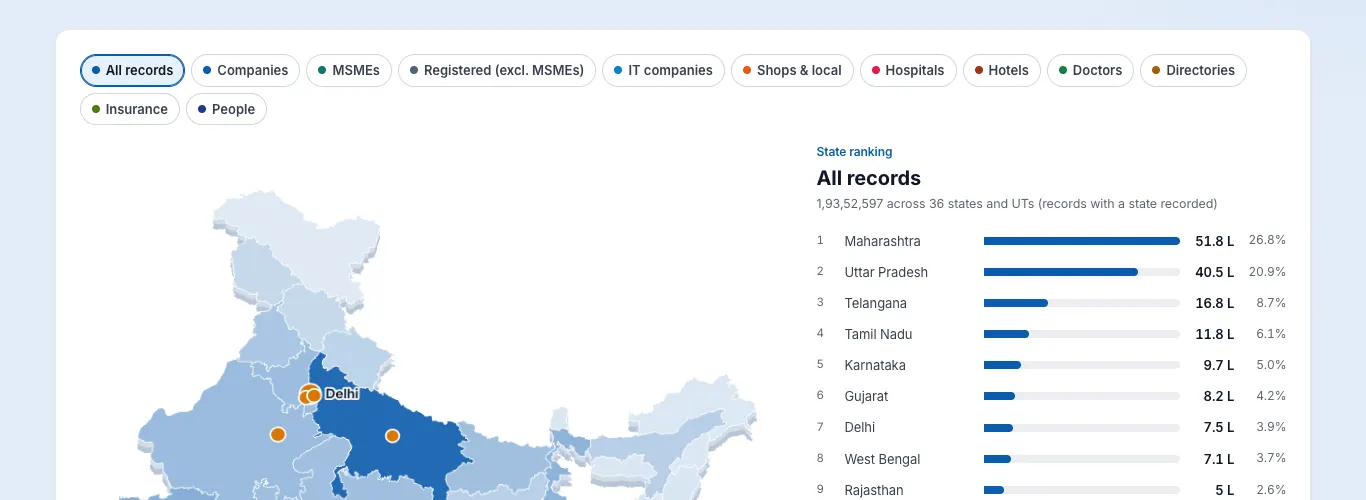
The state-by-state view on LeadSetu's Data page: pick a category to rank states by count. Screenshot from October 2026; the counts change daily.
How to buy B2B data legally in India
- Write down your purpose: the industries, places, company sizes and roles you sell to, and why those people would expect to hear from you.
- Choose only the fields you need: company fields for targeting, and the named-person fields for the roles you will actually contact.
- Ask the provider for the source and date of every personal field, and how each email is known (published or pattern-built).
- Check the provider's own privacy notice, grievance officer and opt-out process, and whether an opt-out is honoured for every customer it serves.
- Load the data into one system (a CRM) rather than spreadsheets, so opt-outs and deletions apply everywhere.
- In every first message, say who you are, why you are writing and how to opt out; for calls and SMS, scrub against the DND register first.
- Act on every opt-out, correction and erasure request quickly, and delete data you no longer need for the purpose you bought it for.
Steps 5 and 7 are where most teams slip. A list copied into five spreadsheets cannot be cleaned when one person opts out. In LeadSetu the data and the CRM are one system: an opt-out recorded against a person or a domain applies to search results, exports and campaigns, and your own do-not-contact list sits next to ours.
Questions to ask a data provider
| Question | A good answer |
|---|---|
| Where did this email come from? | A page address and the date it was read, or a register name |
| Is this email published or built from a pattern? | A clear label on every email |
| What happens when someone opts out? | It applies to every customer and every export, at once |
| Who is your grievance officer? | A named role and a working contact on a public privacy page |
| Do you sell sensitive personal data? | No |
| Can I keep my own suppression list? | Yes, applied before every export and campaign |
| Is there an export audit log? | Yes, by user and date |
If a provider cannot answer the first two questions, you cannot answer a person who asks you where you found their details, and that is the question the DPDP Act expects you to be able to answer.
For a longer vendor-neutral checklist on coverage, exports and CRM fit, see How to choose a B2B data provider. For more guides like this one, see the B2B data guides hub.
Frequently asked questions
Is it legal to buy B2B data in India?
Yes, buying company data is legal, and so is buying contact details of business people, as long as you then handle the personal part under the DPDP Act: a lawful basis, clear notice in your outreach, easy opt-outs, purpose limits and security. Buying data that was obtained unlawfully, or using it for something the person would not expect, is where the risk lies.
Does the DPDP Act apply to work email addresses?
Yes. A work email that identifies a person is personal data. A shared mailbox that does not identify a person, such as a general sales address, is usually not. The Act does not apply to personal data the person has made publicly available themselves, which is why the source page of each email matters.
Do I need consent before sending a B2B cold email in India?
The Act's main ground for processing is consent, and the exceptions are narrow, so the safe course is to keep first contact short and relevant, say who you are and why you are writing, ask whether the person wants to hear more, and stop at once if they say no. Many teams use the first email to seek that agreement. Take legal advice for a large programme.
What about calling or sending SMS to numbers on a bought list?
Promotional calls and SMS fall under TRAI's commercial communication rules. Scrub numbers against the National Customer Preference Register (DND) through a registered telemarketer, use registered SMS headers and templates, and keep your own do-not-call list.
What should I do when someone asks me to delete their data?
Delete or suppress it everywhere you hold it, tell your data provider if the request concerns their data, and keep a minimal suppression record so the person is not added back by the next import. Do it promptly and keep a note of when it was done.
Sources and method
The law in this guide is a plain-words summary of the Digital Personal Data Protection Act, 2023, the Digital Personal Data Protection Rules, 2025 and TRAI's commercial communication regulations, as published by the Government of India and TRAI; read the official texts for the exact wording. The counts are aggregate figures from LeadSetu's own database on 10 November 2026, built from public company websites and official registers; they are the same counts as on the IT companies in India page, which is updated as the data changes. No individual's data is shown in this guide.
Ready to see the data? Search companies and decision makers on the Data page, or share your requirement and we will send a sample.
B2B data India DPDP Compliance B2B data guide AI draft