B2B directory India: directory vs database vs marketplace
Short answer: a B2B directory lists businesses by category and place so you can find them; a B2B database gives you structured, filterable records with contacts so you can work a list; a B2B marketplace brings buyers and sellers together around products and enquiries. In India most sellers use more than one: a marketplace or directory to be found, and a database to go out and find buyers themselves.
The three words get used loosely, and sellers often pay for the wrong one. A manufacturer who wants to call 500 distributors in Gujarat does not need a marketplace listing. A trader who wants buyers to find him does not need a database. This guide explains the difference plainly, shows what a directory covers with our own counts, and gives a simple way to choose.
Disclosure: this guide is published by LeadSetu, which runs a B2B directory and sells B2B data with a CRM built in. We describe the other kinds of service by what they do; we do not name or rate other companies.
Contents
- The three models in one table
- B2B directories
- B2B databases
- B2B marketplaces
- What a directory covers: real counts
- How to choose between a directory, a database and a marketplace
- Using them together
- Frequently asked questions
- Sources and method
The three models in one table
| B2B directory | B2B database | B2B marketplace | |
|---|---|---|---|
| Main job | Find businesses by category and place | Build and work a filtered list of prospects | Match buyers and sellers around products |
| Who starts the contact | You, after browsing | You, outbound | Usually the buyer, by enquiry |
| How it is organised | Category, city, PIN code | Fields and filters: sector, type, size, location, contacts | Product listings and buy requirements |
| What sellers usually pay for | Often free to browse; paid listings or contacts | A subscription or a list | A paid listing or a package of enquiries |
| Strength | Breadth of local businesses, easy browsing | Control: you choose exactly who to contact | Inbound buyers with a stated need |
| Limit | Thin filters, few named decision makers | You still have to make the contact | Enquiries are shared; many sellers quote |
B2B directories
A directory answers "who are the businesses of this kind in this place?" India has many: local search directories and listing apps, city and trade guides, chamber of commerce member lists, export council member lists, and regulators' public lists of licence holders. Some are general; many are specialised, such as a council's list of handicraft exporters or a regulator's list of registered mutual fund distributors.
A directory is good for:
- seeing the shape of a local market: how many hospitals, schools or wholesalers a district has;
- finding a specific kind of business near you, quickly;
- checking that a business exists and what category it belongs to.
It is weaker for outbound sales at scale. Filters are usually limited to category and place, few directories tell you a company's size or business type reliably, and named decision makers are rare. Many listings are created once and never updated, so check the date.
B2B databases
A database answers "which exact companies should my team contact this month, and how?" Each business is a record with fields you can filter on: sector, sub-industry, business type (manufacturer, distributor, dealer, exporter, service provider), city, state, PIN code, company age, contacts and the source of each contact.
A database fits when:
- you sell outbound, by phone, email or field visits;
- you need a list cut to a precise segment, such as "pharma distributors in Telangana with a phone";
- you want the list inside your CRM, with every call and reply tracked against the record.
The limit is that a database does not create demand. It tells you who to contact; your team still has to make the call, and the businesses on the list have not asked to hear from you. That makes relevance and respect for opt-outs more important, not less. Our guide to what a company database should contain goes through the fields.
B2B marketplaces
A marketplace answers "who wants to buy this product right now?" Sellers list products, often with prices and specifications. Buyers search, send enquiries or post a requirement, and the marketplace passes the enquiry to one or more sellers. India's large B2B marketplaces cover thousands of product categories and are widely used by small manufacturers and traders, especially for industrial supplies, packaging, machinery, chemicals and building materials.
A marketplace fits when:
- your product is standard enough that buyers search for it by name;
- you can respond to enquiries within minutes and quote quickly;
- you are building visibility and do not have a large sales team.
Things to know before paying for a listing: an enquiry is often shared with several sellers, so speed of reply decides who wins; enquiry quality varies by category, from serious bulk buyers to one-off retail requests; and you are found only by buyers who already know what to search for. A good habit is to put every marketplace enquiry into your CRM the moment it arrives, so none is lost and you can see which categories actually turn into orders.
What a directory covers: real counts
To make this concrete, here is what LeadSetu's own Business Directory counts on 20 November 2026: 43,91,553 Indian businesses and institutions in 94 categories, each counted once. The twelve biggest groups:
| Group | Businesses | Categories |
|---|---|---|
| Health | 5,83,994 | 9 |
| Shops and retail | 4,28,844 | 8 |
| Finance | 4,06,114 | 7 |
| Education | 3,97,113 | 4 |
| Travel | 3,55,295 | 3 |
| Trade (manufacturers, transport, exporters, warehouses) | 3,06,639 | 4 |
| Food | 2,98,751 | 1 |
| Local services | 2,82,711 | 7 |
| Showrooms | 2,55,274 | 12 |
| Real estate and construction | 2,53,084 | 7 |
| Institutions | 1,32,262 | 5 |
| Wholesale and distribution | 1,16,277 | 1 |
Within that, our trade and professional lists alone hold 13,23,624 records from published member and licence lists. The biggest categories in those lists:
| Category (from trade and professional lists) | Records |
|---|---|
| Mutual fund distributors | 2,01,196 |
| Manufacturers | 1,54,333 |
| Food businesses | 79,813 |
| IT companies | 57,825 |
| Wholesalers | 56,307 |
| Builders and developers | 55,306 |
| Contractors | 49,364 |
| Colleges | 45,217 |
| Pharmacies | 38,149 |
| Exporters | 23,043 |
Of those 13,23,624 records, 9,77,673 carry a business email and 7,63,174 a business phone, because member and licence lists usually publish a contact for each member.
The directory pages show counts by category, state, city and PIN code, plus sample business names. Contacts open only in the app. That is the line between a directory and a database in our own product: the directory helps you see the market, the database in the app lets you work it.
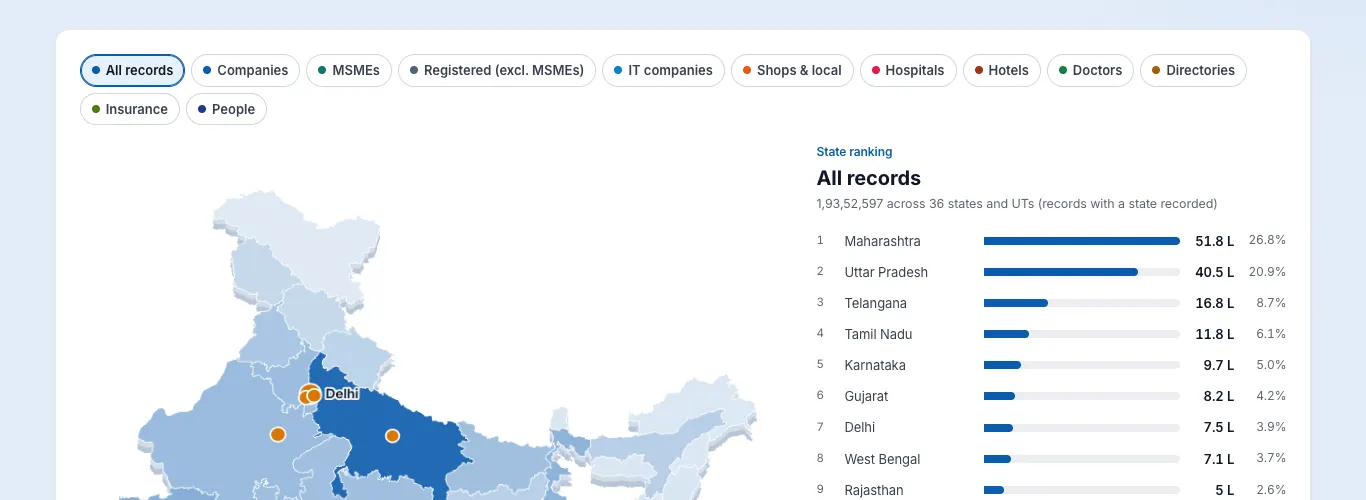
The state ranking on LeadSetu's Data page, which works the same way for each directory category. Screenshot from October 2026; counts change daily.
How to choose between a directory, a database and a marketplace
- Ask who starts the conversation. If buyers come to you, a marketplace or a directory listing helps. If you go to them, you need a database.
- Ask how standard your product is. Buyers search marketplaces for standard products; a custom or service product is usually sold outbound.
- Ask how precise your target is. "Any buyer of corrugated boxes" suits a marketplace. "Food processors in Pune with over 50 staff" needs the filters of a database.
- Ask how many people will work the leads. One founder answering enquiries suits a marketplace; a team of five callers needs a list split by territory, in a CRM.
- Ask what you can measure. Whatever you choose, track every enquiry and every call to an order, then keep the channel that produces orders, not the one that produces the most leads.
Using them together
Most growing Indian B2B sellers end up using all three:
- a marketplace listing or directory profile so buyers who search can find them;
- a database to go after the segments that do not search, such as hospitals, large manufacturers or new companies;
- a CRM where enquiries from every channel and outbound calls sit in one place, with follow-ups that do not depend on anyone's memory.
Whatever mix you choose, review it once a month with three numbers per channel: leads received or contacted, conversations that reached a decision maker, and orders. A channel that produces many enquiries but few orders may still be worth keeping for visibility, but it should not take most of your team's time. A channel that produces a handful of large orders deserves more effort, even if it feels slow.
Take a simple example. A pump manufacturer in Coimbatore gets enquiries from a marketplace listing, mostly from farmers and small contractors buying one pump at a time. It also wants dealers in Karnataka and Andhra Pradesh, and industrial buyers such as textile mills and food processors. The marketplace handles the first group well. The second and third groups rarely post enquiries, so the manufacturer builds a list of pump and electrical dealers and of mills in those states, and calls them. Both channels feed one CRM, so the owner can see which one actually brings orders.
LeadSetu combines the second and third: one plan with Data and CRM for up to 5 users, priced on the pricing page, with a free trial of 10 records (view and copy only). Our Data catalogue shows what each sector and city holds before you sign up, and the Directories page describes the trade and professional lists.
Frequently asked questions
What is a B2B directory in India?
A B2B directory lists Indian businesses by category and place, such as manufacturers in Rajkot or hospitals in Patna, so you can find and check them. LeadSetu's directory counts 43,91,553 businesses in 94 categories on 20 November 2026.
What is the difference between a B2B directory and a B2B database?
A directory helps you browse and find businesses by category and place. A database gives you structured records with many fields and filters, and contacts with their source, so you can build a precise prospect list and work it in a CRM.
Is a B2B marketplace better than a database?
Neither is better in general. A marketplace brings buyers who are already searching for your product; a database lets you reach buyers who are not searching. Standard products often do well on marketplaces; custom products and services usually need outbound work from a database.
Are B2B directories in India free?
Many are free to browse. Contacts, listings and enquiries are usually paid. On LeadSetu, browsing the directory counts and categories is free, and contacts open in the app with the plan.
How does a business get into LeadSetu's directory?
It is built from official registers, published business listings, trade and professional lists and public business websites. If your business is listed and you want a detail corrected or removed, use the privacy and opt-out form.
Sources and method
Directory counts are from LeadSetu's Business Directory pages and our trade and professional lists on 20 November 2026; each business is counted once across categories. Contact counts are aggregate figures. Descriptions of directories and marketplaces are general and do not refer to any one company. Data comes from official registers, published member and licence lists and public business websites. No individual's details appear in this guide.
See the coverage on the Data page and the B2B database India page, share your requirement or contact us. More guides: B2B data guides.
B2B data India B2B directory Buying guide B2B data guide AI draft