
Company database India: what a good one contains, field by field
Short answer: a useful company database for India gives every company a clean name, its legal identity where it has one, a sector and business type, a city, state and PIN code, and contacts that each name their source. It also says when the record was last checked. Ask how often it is rebuilt, where each field comes from and how closed companies are removed, then test 50 records yourself.
Most buyers judge a company database by its headline count. That is the wrong place to start. A list of 20 lakh companies with no phones, wrong cities and companies that closed in 2019 is worth less than 20,000 clean records. This guide goes through a company record field by field, shows what our own India data holds for each field, and gives a short test you can run on any database before you pay for it.
Disclosure: this guide is published by LeadSetu, which sells B2B data for India with a CRM built in. The examples use our own data; the checks apply to any provider.
Contents
- Three kinds of company data
- The fields, one by one
- Contacts and where they come from
- How to judge freshness
- How to judge sources
- How to test a company database before you buy
- Personal data inside a company database
- Frequently asked questions
- Sources and method
Three kinds of company data
A company database for India is usually built from three kinds of source, and each has a different strength.
| Source kind | What it gives well | What it lacks |
|---|---|---|
| Official registers (company register, Udyam, licences) | Legal name, identity number, legal form, registration date, registered address | Phones, what the company actually sells, who decides |
| The company's own website | What it does, where it operates, published email and phone, named people | Legal form, and companies with no website |
| Trade and professional lists (associations, councils, regulators' public lists) | Membership of a trade, licence type, a category you can trust | Coverage outside that trade |
A good database merges the three into one record per company and keeps the source of every field. Our IT companies section shows how the mix looks in practice. On 20 November 2026 it holds 1,90,405 Indian IT companies: 1,20,354 come primarily from the company's own website, 65,168 from a register and 4,883 from a trade or professional listing, with matching records merged into one.
The fields, one by one
Here is a full company record, what each field is for, and what to check.
| Field | Why it matters | What to check |
|---|---|---|
| Company name | Search, de-duplication, the first line of your email | Clean case, no "M/S" or legal suffix clutter, one record per company |
| Legal form | Pvt Ltd, LLP, OPC, partnership, proprietorship | Tells you who signs and how formal the buying will be |
| Identity number | CIN, LLPIN or Udyam number | Lets you confirm the company on the official register |
| Status | Active, struck off, under liquidation | A struck-off company should not be in a sales list |
| Year of incorporation | Company age | New companies buy set-up services; older ones replace vendors |
| Sector and sub-industry | Targeting | Is it the database's guess or verified against the website? |
| Business type | Manufacturer, distributor, dealer, exporter, service provider | The single most useful filter for B2B selling |
| City, state, PIN code | Territories and field visits | Is the state derived from the PIN, or typed free-form? |
| Branch locations | Multi-city companies | A company with offices in five cities should not count five times |
| Website and domain | The check on everything else | Does the site still load? |
| Business email | Email outreach | Its source page, and whether the domain accepts mail |
| Business phone | Calling teams | Its source, and whether it is a landline, mobile or toll-free line |
| Named people and roles | Reaching the decision maker | Only people the company itself publishes, with a role |
| Last checked | Freshness | A date on each record, not just "updated regularly" |
Two fields deserve extra attention.
Business type separates a pump manufacturer from a pump dealer and a pump repair shop. All three may sit under "pumps", but they buy completely different things. If a database cannot filter by business type, you will spend your first week cleaning.
Branch locations matter for larger companies. In our IT data, 51,201 of 1,90,405 companies have more than one office location merged into a single record. Without that merge, a company with offices in Pune, Bengaluru and Noida would appear three times, and three of your salespeople would call it.
Contacts and where they come from
Contacts are what you pay for, so look closely. For the 1,90,405 IT companies in our data on 20 November 2026:
| Contact | Companies | Share |
|---|---|---|
| A business email | 1,70,512 | 89.6% |
| A business phone | 96,856 | 50.9% |
| Named people published by the company | 41,275 | 21.7% |
| At least one named decision maker | 32,035 | 16.8% |
Across all Indian businesses with their own website (12,16,364), 4,82,320 show a business email and 9,92,777 a business phone. Sector changes the mix a great deal: IT firms publish emails, while shops, clinics and local services publish phones.
A good database tells you where each contact was found: the page on the company's site, the register filing or the trade list. That matters for three reasons. You can judge it yourself. You can tell the person where you found their details, as the DPDP Act expects. And when a contact goes stale, you know which source to recheck.
Be careful with personal emails for named people. Very few small companies publish their directors' email addresses. Of the people at Indian companies in our data, 35,412 have an email published on the company's own site; for most others an address can only be inferred from the company's email pattern. Treat an inferred address as unconfirmed until it is verified, and never present it as published.
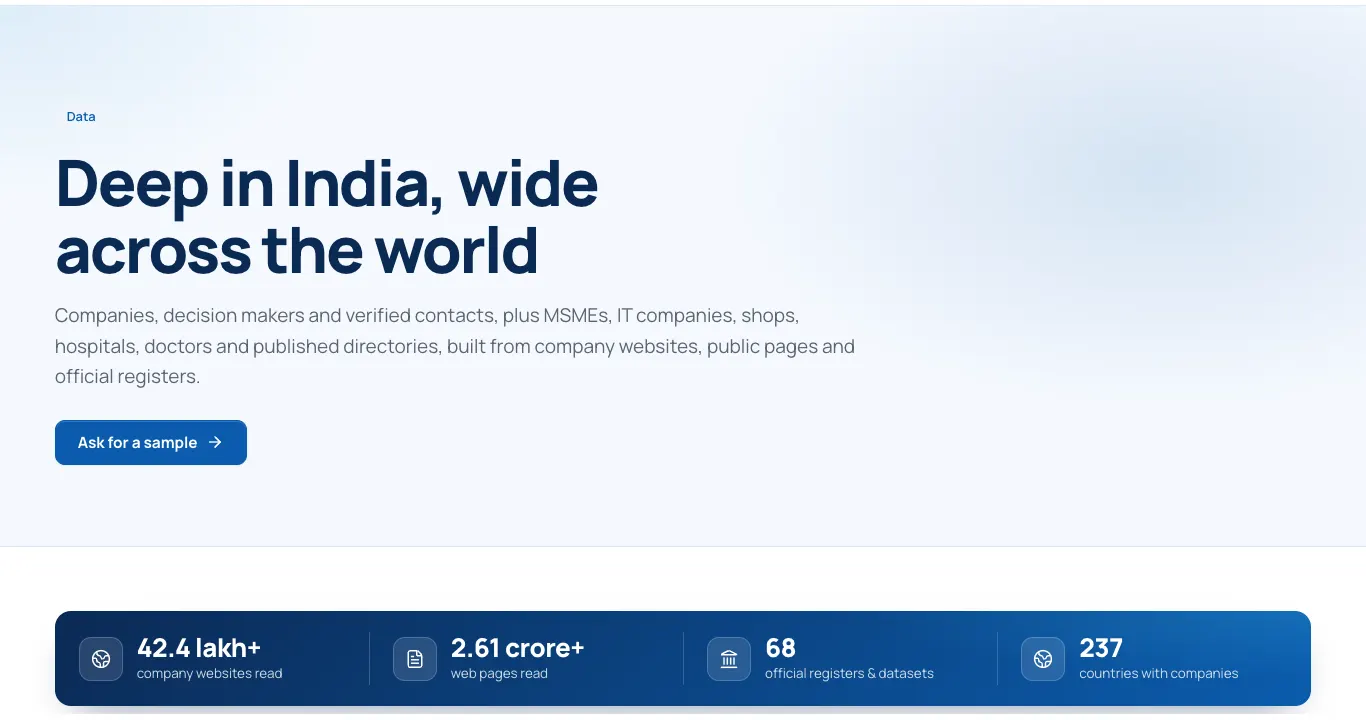
Coverage by category and contact type on LeadSetu's Data page. Screenshot from October 2026; counts change daily.
How to judge freshness
"Updated regularly" means nothing on its own. Ask these questions instead:
- How often is the database rebuilt? Ours is rebuilt every day; the IT companies table used for this guide was built on the morning of 20 November 2026. A database rebuilt once a year will be a year out of date by the end of it.
- How are closed businesses removed? Look for two mechanisms: register status (struck off, dissolved) and dead websites. In our IT data 1,10,263 companies carry an "Active" status from the register; the rest come from websites and lists, where a working site is the signal.
- Is there a date on each record? You should be able to see when a record was last checked, not just when the file was made.
- How quickly do new companies appear? In our register data, 2,25,993 companies were incorporated in 2025. A database that adds them months late misses the companies most open to new vendors.
How to judge sources
Every field should be traceable. A good provider can tell you, for any record, which register, website page or trade list each field came from. Ask for that before you buy.
Be wary of a database that cannot explain its sources, or one that quotes a single huge total with no breakdown by state, sector and contact type. A real database has uneven coverage, and an honest provider shows the gaps. In our own data, for example, the company register gives a filed email for 8,20,544 of 21,38,618 registered companies but a phone for only 10,109. We say so, because it changes how you should use those records.
How to test a company database before you buy
- Pick 50 records in your own segment: your sector, your cities, the business type you sell to.
- Open each company's website and check the name, city and what it does against the record.
- Check the status of the registered companies on the official register.
- Call 10 of the phone numbers and send nothing yet; just confirm the number reaches the business.
- Look at where each email came from. Published on the company's own page is good; "pattern" or "guessed" should be labelled as such.
- Count the duplicates: the same company under two names or two cities.
- Score it: how many of the 50 would your team actually work? That number, not the headline total, tells you what the database is worth.
LeadSetu's free trial opens 10 records in the app, view and copy only, so you can run most of this test on our data before deciding. The plan, Data and CRM for up to 5 users, is on the pricing page.
Personal data inside a company database
Company records are mostly not personal data. A named director's work email, a proprietor's mobile or a doctor's clinic number are personal data under the Digital Personal Data Protection Act, 2023. Use them only for relevant business outreach, say who you are and where you found the details, give an easy way to opt out, and honour every opt-out. Our guide on how to buy B2B data in India legally covers the rules, and finding decision makers' emails ethically covers named contacts.
Frequently asked questions
What is a company database?
A company database is a structured list of businesses with one record per company: its name, legal identity, sector, location and contacts, ideally with the source of each field and the date it was last checked.
Which fields matter most in a company database for India?
Business type, city and PIN code, and contacts with their source. Business type and location decide whether a company is a prospect at all; contacts with a source decide whether you can reach it properly.
How often should a company database be updated?
As often as the businesses in it change. New companies are registered every day and websites close every week, so a database should be rebuilt at least monthly. LeadSetu rebuilds its data every day.
Does a company database include employee emails?
Sometimes. Only use named people that the company itself publishes, and treat any address inferred from a naming pattern as unconfirmed until it is verified.
Can I download a full company database of India?
Not from LeadSetu. The plan works in the app: you search, open records and work them in the built-in CRM, with view and copy only. If you need a custom file for one sector or state, share your requirement.
Sources and method
Figures are aggregate counts from LeadSetu's data on 20 November 2026: the IT companies table (sources, contacts, people, branch locations and register status), our index of Indian business websites, our copy of the company register and the people published on company websites. Data comes from official registers, trade and professional lists and public company websites. No individual's details appear in this guide.
Browse the India data on the Data page, the B2B database India page and the IT companies in India page, or contact us. More guides: B2B data guides.
B2B data India Company database Data quality B2B data guide AI draft