
How to find buyers for your product in India: a practical method
Short answer: start from how your product is used, not from a list. Decide whether buyers use it as a raw material, a component, equipment, a consumable, stock for resale or a service. That tells you which industries buy it and who signs the order. Then build a short list of those businesses in the places you can serve, add free routes such as GeM, tenders, trade fairs and export councils, and follow up every lead in one CRM.
"Where do I find buyers?" is the question we hear most from small manufacturers, traders and service firms. The honest answer is that buyers are not hidden; they are scattered across industries you may not have thought of. A corrugated box maker sells to food processors, pharma companies, e-commerce sellers and auto-parts makers, and each of those buys differently. This guide gives a method that works for most products, the buyer counts behind it from our own data, and the free routes that cost nothing but time.
Disclosure: this guide is published by LeadSetu, which sells B2B data for India with a CRM built in and runs the buyer–seller matching tool mentioned below. The free routes in this guide work without any paid service.
Contents
- Step one: how is your product used?
- Who buys, in numbers
- How to find buyers for your product
- Free routes: GeM, tenders, fairs and councils
- Three worked examples
- What to say when you reach a buyer
- Frequently asked questions
- Sources and method
Step one: how is your product used?
Every B2B product reaches its buyer in one of six ways. The way decides who buys, how often, and who in the buying company decides.
| How the buyer uses it | Example products | Typical buyers | Who usually decides |
|---|---|---|---|
| Raw material | Steel, yarn, plastic granules, chemicals | Manufacturers in the matching industry | Owner or purchase head |
| Component | Fasteners, bearings, PCBs, castings | Machine and equipment makers, auto-parts makers | Purchase with engineering sign-off |
| Equipment | CNC machines, compressors, boilers | Factories, workshops, hospitals, labs | Owner or plant head; a capital decision |
| Consumable | Packaging, lubricants, office and lab supplies | Almost every business in the sector | Purchase or stores; repeat orders |
| Resale | FMCG, electricals, apparel, hardware | Distributors, wholesalers, dealers, retailers | Owner; margin and credit terms matter |
| Service | Software, logistics, testing, maintenance | Companies by size and sector | Owner or function head |
Two practical points follow from this table.
First, raw materials and components are sold to a narrow set of industries, so your list is short and precise. A forging maker does not need every manufacturer in India; it needs auto-parts, pump, valve and machinery makers within reach of its plant.
Second, products for resale move through a chain: manufacturer, then distributor or wholesaler, then dealer, then retailer. Do not call 10,000 retailers if 300 distributors can carry your product to them. Find the distributors first.
Who buys, in numbers
Once you know the buyer industries, size them. Here is how our data groups Indian businesses by the kind of buyer they are likely to be, on 20 November 2026.
| Buyer segment | Businesses with a website | Udyam MSMEs | What they commonly buy |
|---|---|---|---|
| Suppliers and manufacturers | 2,56,010 | 15,39,729 | Raw materials, components, machinery, packaging, logistics |
| Local services | 2,50,466 | 11,01,437 | Software, payments, marketing, supplies |
| Construction and infrastructure | 1,83,468 | 5,89,162 | Building materials, equipment, contractors |
| Retail | 97,515 | 7,28,245 | Stock for resale, billing tools, fit-outs |
| Healthcare | 78,728 | 1,49,388 | Medical supplies, diagnostics, equipment |
| Real estate | 65,591 | 3,42,154 | Materials, marketing, finance |
| Agriculture | 11,046 | 3,99,465 | Inputs, equipment, storage |
For products that move through a trade chain, these are the intermediaries in our trade and professional lists:
| Intermediary type | Records |
|---|---|
| Manufacturers | 1,54,333 |
| Wholesalers | 56,307 |
| Builders and developers | 55,306 |
| Contractors | 49,364 |
| Pharmacies | 38,149 |
| Exporters | 23,043 |
| Pharma companies | 20,033 |
| Auto dealers | 19,887 |
| Logistics companies | 19,295 |
| Agri input dealers | 8,820 |
The numbers show why the "who uses it" step matters. A seller of billing software has lakhs of possible buyers among retailers and local services. A seller of industrial boilers has a few thousand, and should know most of them by name.
How to find buyers for your product
- Write your product's use in one line: "a consumable for food processors" or "a component for pump makers".
- List the buyer industries for that use, and for products sold for resale, the distributors and wholesalers in your category.
- Look at your five strongest existing customers and note what they have in common: sector, business type, city size, how long they have been in business.
- Pick the states and cities you can deliver to and service, and stay inside them for the first round.
- Build a list of 200 to 500 businesses that match, with a phone or email for each, and load it into your CRM by territory.
- Add the free routes below: register on GeM if government buyers use your product, and plan one trade fair in the year.
- Contact the list in small batches, record every reply, and after a month keep the industries and cities that responded.
LeadSetu's Find buyers tool does steps 2 to 5 for you. You pick what you make or sell, and it shows which kinds of businesses buy it and why (as raw material, component, equipment, consumable, resale or service), then lists matching Indian businesses ranked by the strength of the trade link, nearness and which contacts are on file. You can also give it a few of your strongest customers and it finds similar businesses. It describes likely trade links; it does not promise a sale. The same page has a Find suppliers mode for the other side of the trade.
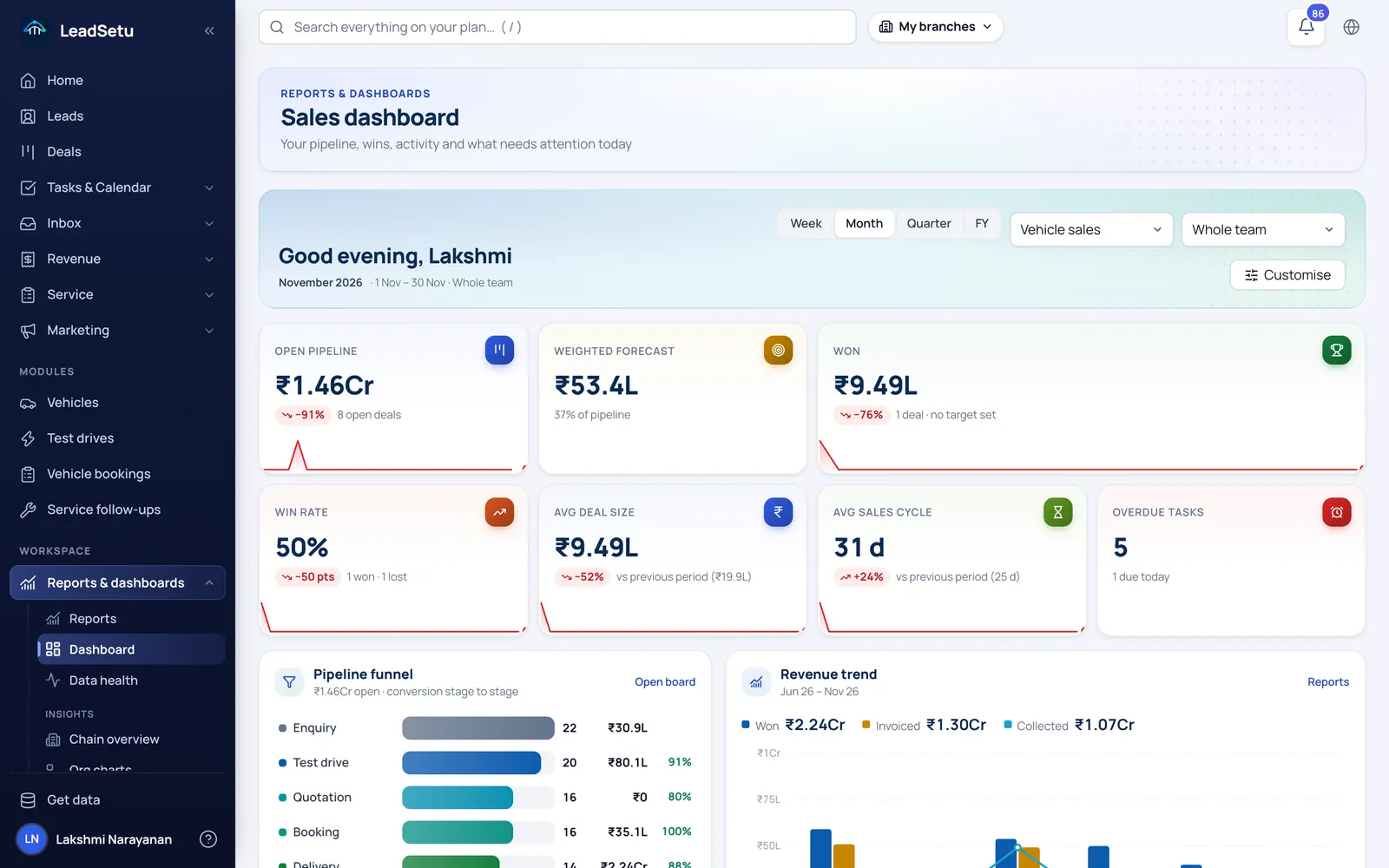
The LeadSetu CRM dashboard, where matched buyers become deals with follow-ups. Screenshot with sample data.
Free routes: GeM, tenders, fairs and councils
You do not need to pay anyone to find buyers. These routes are free or close to it, and every Indian B2B seller should know them.
Government e-Marketplace (GeM). GeM is the government's online marketplace for goods and services bought by central and state ministries, departments and public sector undertakings. Sellers register, list products or services and take part in bids. Under the Public Procurement Policy for Micro and Small Enterprises, central ministries, departments and public sector undertakings are expected to buy at least 25% of their annual procurement from micro and small enterprises, so a Udyam-registered seller has a real opening. Read the bid conditions carefully: delivery terms, inspection and payment timelines are fixed by the buyer.
Tenders. Public tenders are published on the Central Public Procurement Portal and on state and PSU e-procurement portals. They suit equipment, works contracts and services. Start with small-value tenders in your own district to build a record of supply.
Trade fairs. A good fair puts hundreds of buyers in one hall for a few days. The India International Trade Fair is held every November at Bharat Mandapam in New Delhi, organised by the India Trade Promotion Organisation, and most industries have their own specialised fairs for machinery, packaging, textiles, pharma and food. Go with a list of the exhibitors and visitors you want to meet, not just a stall.
Export promotion councils. If you want buyers abroad, the council for your product (engineering, pharma, apparel, handicrafts, chemicals and others) runs buyer-seller meets, overseas fairs and member directories. Membership gives you a Registration-cum-Membership Certificate, needed for many export benefits. Our guide to lead generation for exporters covers overseas buyers in detail.
Your own customers. Ask each satisfied customer for one introduction to a business like theirs. It is slow, but a buyer who comes through a customer already has a reason to trust you.
Three worked examples
A corrugated box maker in Pune. Use: consumable packaging. Buyers: food processors, pharma companies, FMCG and auto-parts makers, and e-commerce sellers within delivery range. Route: a list of manufacturers in Pune, Satara and the Chakan and Ranjangaon industrial belts, filtered to those with a phone, then visits to the ones that answer. GeM for government stationery and packaging bids.
A software firm selling clinic management software. Use: service. Buyers: clinics, dental clinics, diagnostic labs and small hospitals. Route: a city-by-city list from the healthcare segment, starting with the cities where the firm already has customers; email first, then a call. No marketplace needed, because clinics rarely search for this; they are reached.
An LED lighting maker in Delhi NCR. Use: resale and equipment. Buyers: electrical wholesalers and dealers for resale; builders, contractors and hospitals for projects. Route: wholesalers and contractors from trade lists, GeM for government lighting bids, and one lighting and electrical fair a year.
What to say when you reach a buyer
Keep the first message short and about them: what you make, which businesses like theirs use it, and one concrete reason to talk (a delivery time, a rate on a standard size, a certification). Say who you are and how you found them, and offer a clear way to say no. Under India's DPDP Act a named person's contact details are personal data: use them only for relevant business outreach and honour every opt-out. Read how to buy B2B data in India legally before a large campaign.
Frequently asked questions
How do I find buyers for my product in India?
Decide how buyers use your product (raw material, component, equipment, consumable, resale or service), list the industries that use it that way, size them in your region, build a short list with contacts, and add free routes such as GeM, tenders, trade fairs and export councils. Track every lead in one CRM.
How can a small manufacturer find bulk buyers?
Target the industries that use your product as a raw material, component or consumable, and the distributors and wholesalers in your category. Bulk buyers are usually other manufacturers and distributors, not retailers.
Is GeM useful for MSMEs?
Yes, if government buyers use your product or service. GeM is open to registered sellers, and the Public Procurement Policy for Micro and Small Enterprises expects central buyers to source at least 25% of their annual procurement from micro and small enterprises.
What does LeadSetu's Find buyers tool do?
You pick what you make or sell, and it shows which kinds of Indian businesses buy it and why, then lists matching businesses ranked by trade link, nearness and available contacts. It describes likely trade links; it does not promise a sale.
How many buyers should I contact in the first month?
Between 200 and 500 well-chosen businesses is enough for most small teams. Contact them in batches, follow up twice, and keep the industries and cities that respond.
Sources and method
Buyer segment counts are aggregate figures from LeadSetu's index of Indian business websites and our copy of the Udyam register on 20 November 2026; segments are our own grouping by the kind of buyer a business is likely to be. Intermediary counts are from our trade and professional lists. GeM, the Central Public Procurement Portal, the Public Procurement Policy for Micro and Small Enterprises and the India International Trade Fair are described from their official public information. No individual's details appear in this guide.
LeadSetu is one plan, Data and CRM for up to 5 users; see pricing. A free trial opens 10 records, view and copy only. Browse the Data catalogue, the Manufacturers in India page and the Data page, share your requirement or contact us. More guides: B2B data guides.
B2B data India Find buyers Lead generation B2B data guide AI draft