
MSME database India: Udyam enterprises by state and activity
Short answer: an MSME database for India is built on the Udyam register, the Government of India's official registration for micro, small and medium enterprises. The register runs into crores of enterprises across every district of India, and LeadSetu groups them into 108 activity groups. Maharashtra has the most, followed by Uttar Pradesh, Rajasthan and Gujarat. Most are micro businesses: grocery shops, food processors, dairies, tailors, clothing sellers and transporters. The register gives an enterprise name, activity, registration date and address; contacts exist only where the enterprise has its own website.
This guide explains what is in the register, shows how they rank by state and activity, and explains how to sell to MSMEs without wasting your team's time.
Disclosure: this guide is published by LeadSetu, which sells B2B data, including the Udyam register, with a CRM built in.
Contents
- What the Udyam register is
- MSMEs by state
- MSMEs by activity
- MSMEs by registration year
- What an MSME record contains
- How to sell to MSMEs with Udyam data
- Where MSME data fits next to company data
- Common mistakes when selling to MSMEs
- MSMEs and personal data
- Frequently asked questions
- Sources and method
What the Udyam register is
Udyam registration replaced the older Udyog Aadhaar in July 2020. An enterprise registers online, free of charge, and receives a Udyam number. The enterprise is classed as micro, small or medium by its investment in plant and machinery or equipment and its turnover, and registration gives access to government schemes, priority-sector lending and protection on delayed payments from buyers.
For a seller, that makes the register valuable in three ways:
- it covers businesses that no directory or website lists, down to a single-person workshop in a district town;
- every record has an activity, so you can target by what the business does;
- every record has a registration date, so you can find businesses that have just started.
MSMEs by state
| Rank | State |
|---|---|
| 1 | Maharashtra |
| 2 | Uttar Pradesh |
| 3 | Rajasthan |
| 4 | Gujarat |
| 5 | Madhya Pradesh |
| 6 | West Bengal |
| 7 | Telangana |
| 8 | Karnataka |
| 9 | Andhra Pradesh |
| 10 | Bihar |
| 11 | Odisha |
| 12 | Punjab |
| 13 | Assam |
| 14 | Haryana |
| 15 | Delhi |
Two things stand out. Rajasthan, Madhya Pradesh and Bihar rank far higher for MSMEs than for IT companies (Rajasthan is 11th and Madhya Pradesh 12th for IT, and Bihar is outside the top 12), so a list built only from company websites under-represents them. And Maharashtra and Uttar Pradesh together account for more registered MSMEs than any other pair of states. A state-by-state map is on the Data page.
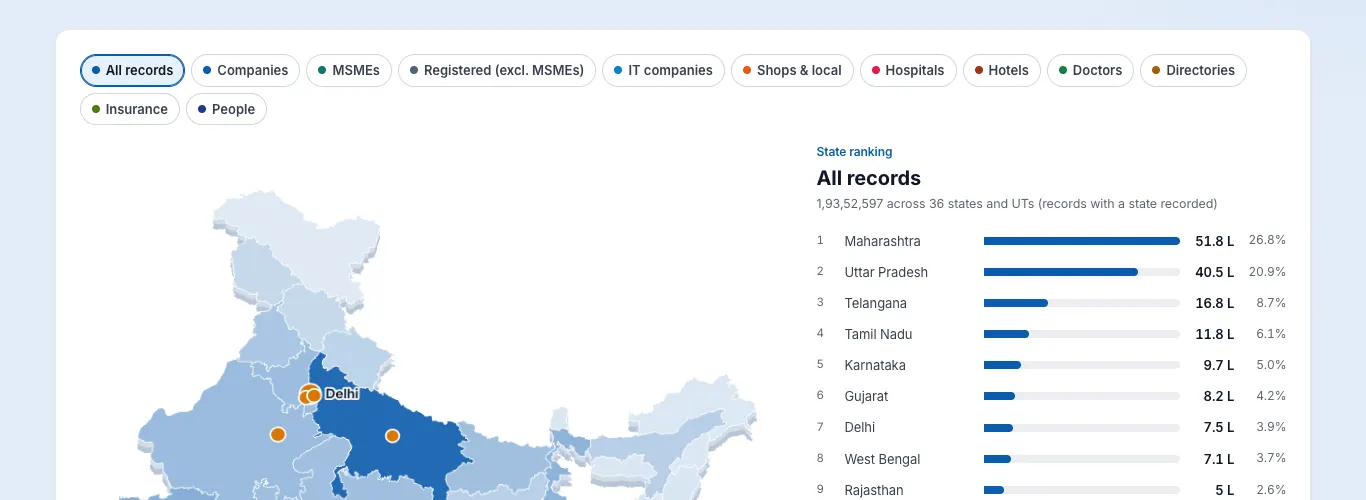
The state ranking on LeadSetu's Data page; choose MSMEs to rank the states by Udyam enterprises. Screenshot from October 2026.
MSMEs by activity
We group each enterprise's declared activity into 108 activity groups. In order of size:
| Activity group (most enterprises first) |
|---|
| Grocery and provision stores |
| Food processing |
| General stores |
| Dairy and milk products |
| Clothing and garments |
| Tailoring |
| Catering |
| Textiles |
| Domestic and household services |
| Travel and tour services |
| Restaurants |
| Trucking and road freight |
We also tag each enterprise with the kind of buyer it is likely to be:
| Segment | Who sells to them |
|---|---|
| Suppliers and manufacturers | Raw materials, machinery, packaging, logistics, finance |
| Local services | Software, payments, marketing, insurance |
| Retail | Distributors, FMCG brands, billing and POS tools |
| Construction and infrastructure | Building materials, equipment, contractors' finance |
| Agriculture | Inputs, equipment, storage, agri finance |
| Real estate | Property services, finance, marketing |
| Healthcare | Medical supplies, diagnostics, software |
MSMEs by registration year
Every Udyam record carries its registration date, and most records in the register were registered from 2023 onward, so there is a fresh list of new businesses every month. New businesses can be responsive buyers: they are setting up suppliers, banking, software and insurance for the first time.
What an MSME record contains
| Field | In the register | Notes |
|---|---|---|
| Enterprise name | Yes | As registered |
| Activity | Yes | Grouped into 108 activity groups |
| Registration date | Yes | Filter by month or year |
| State, district, city, PIN code | Yes | From the registered address |
| Micro, small or medium | Yes | The enterprise's class |
| Website, email, phone | Only where matched | Added from the enterprise's own website, with the page it came from |
Many micro enterprises have no website. So an MSME list works well for targeting (where, what, how new) and for field sales or partner channels, and less well for bulk email.
How to sell to MSMEs with Udyam data
- Choose the activity groups your product serves, for example dairies and food processors for a cold-chain service.
- Pick the states and districts your sales or distribution team actually covers on the ground.
- Filter by registration date if you sell to new businesses: banking, billing software, insurance and packaging.
- Split the list: enterprises with a website and published contacts for direct outreach, the rest for field visits, local partners or a distributor network.
- Load the list into the CRM by district, so each territory owner sees only their area.
- Track replies and visits by activity group, and drop groups that do not convert after a fair trial.
For manufacturers and suppliers with websites, the Manufacturers in India category adds companies with published contacts; the MSMEs (Udyam) page describes the register data in full.
Where MSME data fits next to company data
The Udyam register and company websites answer different questions. The register tells you that a business exists, what it does, where it is and when it started, even if it has no online presence at all. Company websites tell you who runs the business and how to reach them. For most B2B sellers the useful list combines the two: the register to size a market district by district, and website data to reach the share of enterprises that publish contacts. A distributor planning a new territory, for example, can count the grocery and general stores in each district from the register, then call the wholesalers and manufacturers in that district who list a phone on their own site.
Common mistakes when selling to MSMEs
Treating every MSME as a company. Most Udyam enterprises are proprietorships run by one person who is the buyer, the user and the person who pays. A pitch written for a procurement team, with long PDFs and approval steps, rarely lands. Lead with one concrete outcome in their own trade: fewer stock-outs for a grocer, faster GST invoices for a trader, more orders for a caterer.
Calling at the wrong time. Shopkeepers are busiest in the morning and evening rush and during festival weeks; manufacturers and traders are easier to reach mid-morning and mid-afternoon on working days. Note what time each conversation went well and keep calling at that time.
Buying a list wider than you can work. A small team does better with a few hundred well-chosen enterprises in two or three districts and one activity group than with a state-wide list. Start narrow, measure replies, then widen.
Ignoring the registration date. A business registered last month is choosing suppliers, banks and software now; one registered years ago already has them and needs a reason to switch. Write different first messages for the two.
Skipping the opt-out. A proprietor's phone is a personal number. Say who you are, why you are calling, and stop when asked. It is the law under the DPDP Act, and it protects your number from being reported as spam.
MSMEs and personal data
Most micro enterprises are sole proprietorships, and in a proprietorship the business and the owner are the same person. Treat the owner's name, phone and address as personal data under the DPDP Act: use them only for relevant business outreach, say who you are and how to opt out, and honour every opt-out. LeadSetu removes records that are plainly a private individual rather than an enterprise, and an opt-out made through our privacy form applies for every customer. Read How to buy B2B data in India legally before a large campaign.
Frequently asked questions
How many MSMEs are registered in India?
The Ministry of MSME publishes the official count of Udyam registrations on the Udyam portal, and it grows every day; check the portal for the current figure. The register runs into crores of enterprises.
Which state has the most MSMEs?
Maharashtra, followed by Uttar Pradesh, Rajasthan and Gujarat.
Does an MSME database include phone numbers and emails?
The Udyam register itself does not publish contacts. Where an enterprise has its own website, we add the emails and phones found there, with the page they came from. Many micro enterprises have no website, so not every record has contacts.
Can I get a list of newly registered MSMEs?
Yes. Every record carries its registration date, so you can filter for enterprises registered this month or this year.
Is it legal to use Udyam data for marketing?
The register is official and public, but a proprietor's details are personal data under the DPDP Act. Use them for relevant business outreach, identify yourself, give an easy opt-out and honour it.
Sources and method
Counts are aggregate figures from LeadSetu's copy of the Udyam register on 10 November 2026. Activity groups and buyer segments are LeadSetu's grouping of each enterprise's declared activity. Records that are plainly an individual rather than an enterprise are removed. Data comes from official registers and public company websites. No individual's details appear in this guide.
Filter MSMEs by state, district, activity and registration date on the Data page, or share your requirement. More guides: B2B data guides.
B2B data India MSME Udyam B2B data guide AI draft