Free CRM in India: what you get and what to check
Short answer: a free CRM is worth using in India when its limits on users, records and features still fit your team six months from now. Check the user and lead caps, whether WhatsApp, GST invoices and imports are included, what happens to your data when you upgrade, and whether you can export everything if you leave.
Disclosure: this guide is published by LeadSetu, which makes a CRM with a Free plan. Where we describe LeadSetu, we say so, including its limits. We name no other vendor here; for side-by-side comparisons see our compare page.
Contents
- What "free" usually means in a CRM
- The limits that matter for Indian small businesses
- Free plan, free trial and open-source: a comparison
- How to test a free CRM in one week
- When to move from free to paid
- What LeadSetu's Free plan and trial include
- Frequently asked questions
What "free" usually means in a CRM
Most CRM vendors earn money from paid plans, so a free offer is designed to show you the product and to stay useful only up to a point. That is fair, as long as you know where the point is before your team builds habits around the tool.
Free offers come in three broad shapes:
- A free plan that never expires but has caps: a few users, a limited number of leads or contacts, and some modules switched off.
- A free trial of the full product that ends after a set time, often a few days or a couple of weeks.
- Open-source or self-hosted software where the licence costs nothing but you pay for a server, set-up, updates and someone to look after it.
None of these is automatically better. A two-person trading firm that only needs a follow-up list may live happily on a free plan for a long time. A ten-person sales team with GST invoicing and WhatsApp needs will hit the caps quickly, and a trial tells them more in a week.
The limits that matter for Indian small businesses
Feature lists on pricing pages are long. These are the limits that tend to decide whether a free CRM works for a business in India.
Users and records
Count the people who will log in, including the owner and the accounts person, not only sales. Then count the leads you add in a typical month and multiply by twelve. A cap on leads or contacts sounds generous until a year of enquiries from portals, your website and walk-ins piles up.
WhatsApp and calling
Indian customers often reply on WhatsApp first. Check whether the free plan logs WhatsApp messages on the lead, or only offers a click-to-chat link. If you want approved templates and broadcasts, remember that the WhatsApp Business Platform itself charges for messages, whatever the CRM costs.
GST quotes and invoices
If your sales team raises quotes that become tax invoices, check whether the free plan includes GST quotes and invoices with CGST and SGST or IGST, HSN or SAC codes and your number series. If not, you will keep a second tool for billing and re-type every line.
Imports and exports
A CRM is only as good as the data in it. Make sure you can import your existing Excel or CSV lists with a duplicate check, and, just as important, export all of your leads, deals and tasks if you ever leave. A free plan that limits exports can make leaving harder than joining.
Support
Free plans rarely come with phone support. Ask what help you get: a help centre, email, in-app tickets, and the hours in IST.
Security and privacy
Under India's DPDP Act, you are responsible for the personal data of your customers even on a free plan. Look for two-step sign-in, roles so that a new joiner does not see everything, an audit log and a way to record consent and opt-outs.
Free plan, free trial and open-source: a comparison
| Question | Free plan | Free trial | Open-source, self-hosted |
|---|---|---|---|
| What it costs | Nothing, within the caps | Nothing, for a set time | No licence fee; server, set-up and upkeep cost money and time |
| How long it lasts | No end date | Days or weeks | As long as you maintain it |
| Feature access | Some modules or volumes limited | Usually the full product | Whatever you install and configure |
| Who sets it up | You, in minutes | You, often with sample data | You or a partner |
| Updates and security | The vendor | The vendor | You |
| Data when it ends | Stays; upgrade to lift caps | Check: often deleted after the trial | Stays on your server |
| Good for | Small teams with light needs | Testing a product with your real process | Teams with in-house technical staff |
Use the table to decide which kind of "free" fits, then compare products of that kind.
How to test a free CRM in one week
A week of real use tells you more than a month of demos. Run this plan with two or three people who will actually use the CRM.
- Write down your sales steps on one page: where leads come from, what happens on the first call, when a quote goes out and when you call it won.
- Sign up and set the pipeline stages to match that page, and add the five or six fields your team asks about on every call.
- Import a real list of 50 to 100 leads from Excel, and check how duplicates and blank columns are handled.
- Work those leads for three days: log every call, send WhatsApp messages and set a follow-up date for each one.
- Raise one quote and, if billing matters, one GST invoice, and check the PDF your customer would see.
- Ask the owner to open the dashboard and answer two questions without help: how many leads came in this week, and how many need a follow-up today.
- Export everything you entered and open the file, to confirm you can take your data with you.
- Note every limit you hit, and read what it would cost to lift it.
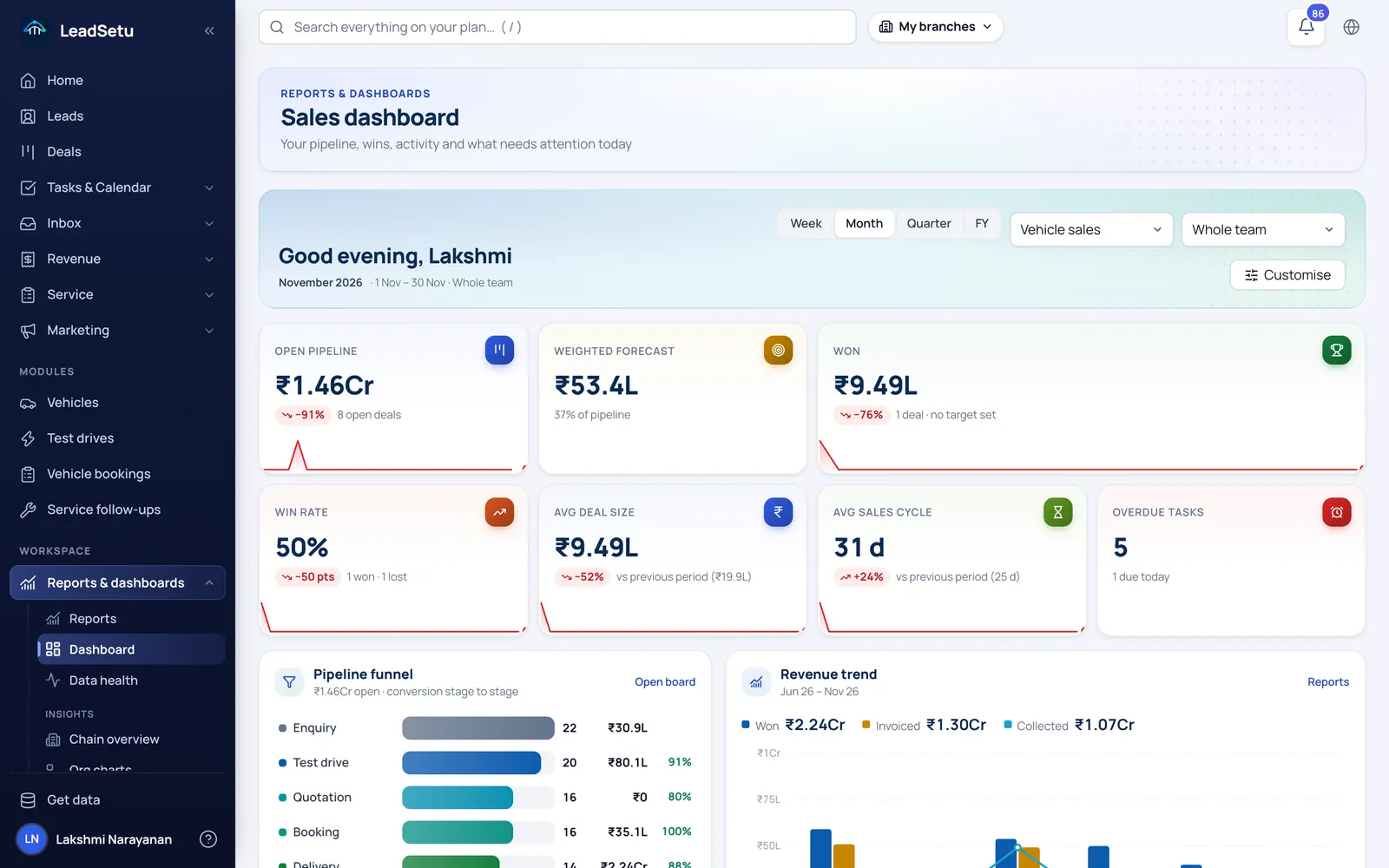
Step 6 in practice: the LeadSetu sales dashboard with demo data. The owner should be able to read the week from one screen.
If the team is still using the CRM on day seven without being reminded, it is a good sign. If they went back to the spreadsheet on day two, find out why before you blame the people.
When to move from free to paid
Free plans are a starting point. These signs usually mean it is time to pay for a plan, with this vendor or another:
- You are deleting old leads to stay under a cap.
- People share a single login because the user limit is reached. That also breaks your audit trail.
- You want automation, such as a reminder when a lead is not called within an hour, and it is a paid feature.
- Billing happens in a separate tool and line items are typed twice.
- You need roles and branch-wise access as the team grows.
When you compare paid plans, ask for the total for your team: the plan, extra modules, languages, WhatsApp, calling, implementation and support. Take each vendor's prices from the vendor directly; they change often.
What LeadSetu's Free plan and trial include
LeadSetu offers two ways to try the CRM without paying, both from our product documentation:
- The Free plan. Start free with no card: confirm your work email and you get the CRM with limits on the number of users and CRM leads, plus a small monthly allowance of credits for the B2B company data. Bulk outreach is off or has a very small daily cap. The exact allowances are shown on the sign-up page under "What the Free plan includes" and in My account. One free account is allowed per company email domain. Your CRM records and lists stay when you upgrade.
- The 24-hour CRM trial. The CRM trial gives you a CRM-only login for a day, already set up for your industry with sample leads, deals and quotes, and no card. Use it to see the full product with a template such as real estate, car dealers or coaching installed.
On paid plans, every CRM module is in one plan: there are no feature tiers for the CRM's modules and builders, and plans differ in counts such as workflows, custom modules and API calls. Single sign-on and SCIM are on Enterprise plans. WhatsApp click-to-chat and call logging are on every plan; for templates and broadcasts you connect your own WhatsApp Business (Cloud API) number, and Meta bills its message charges to you. GST quotes, orders and invoices, e-invoice JSON and GST invoicing features are part of the CRM.
What LeadSetu does not do: there is no app-store mobile app (you install the web app from your browser), offline mode is partial, and live IRN generation needs your own GSP subscription.
For the general checklist that applies to every paid or free CRM, read how to choose CRM software in India. If WhatsApp is your main channel, see WhatsApp CRM for small business.
Frequently asked questions
Is a free CRM safe for customer data?
It can be, but check the same things you would on a paid plan: two-step sign-in, roles, an audit log, where the data is hosted, and how consent and opt-outs are recorded. Under the DPDP Act, your business stays responsible for customer data whatever the plan costs.
Can I move my data out of a free CRM later?
Check this before you start. Export a sample of leads, deals and tasks in the first week and open the file. If exports are limited or missing on the free plan, leaving later will be harder.
Does a free CRM include WhatsApp?
Many include a click-to-chat link from your own phone. Templates, two-way chat inside the CRM and broadcasts need the WhatsApp Business Platform, which charges for messages separately. Ask whether the CRM logs messages on the lead's timeline.
Is a free trial better than a free plan?
A trial is better for testing a product properly, because you see every feature with your own process. A free plan is better if your needs are light and stay light. Many teams use a trial to choose and a paid plan to run.
Does LeadSetu ask for a card to start?
No. The Free plan and the 24-hour CRM trial both start without a card. LeadSetu does not store a card for paid plans either; you get a rupee quote and a GST invoice for every payment.
Related reading
- All CRM guides
- LeadSetu CRM and industry CRM templates
- CRM software for Indian businesses
- CRM with built-in leads
CRM guide Free CRM India Small business